Elegant Bedroom Decor Trends You Need to Try in 2026
1. The Narrative Feature Wall
Modern design has moved beyond simple paint. The primary wall is now treated as a Visual Narrative anchor.
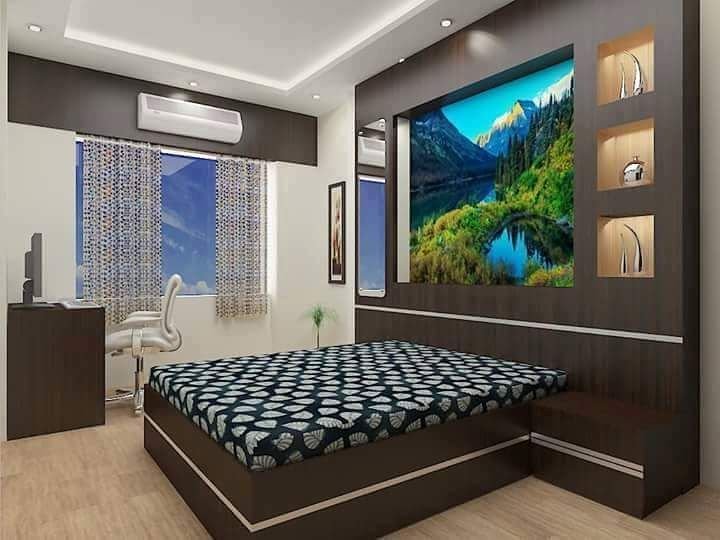
Graphic Murals & Digital Art: Incorporating large-scale backlit graphics or nature-inspired murals—such as mountain landscapes or abstract floral motifs—creates an immediate focal point. This adds “visual depth” to the room, making it feel more expansive.
Integrated Niches: Recessed wall niches with focused downlighting allow for the display of sculpture and art without the need for additional furniture, maintaining a sleek, architectural profile.
2. High-Gloss Reflective Architecture
To create a sense of metropolitan luxury, designers utilize Reflective Planes.
Ceiling Expansion: High-gloss or mirrored ceiling panels effectively “double” the vertical volume of a room. This is particularly effective in urban settings, where it reflects city skylines and sky views directly into the living space.
Material Contrast: Pairing high-shine lacquer surfaces with matte textures (like raw wood or stone) creates a “Material Conflict” that keeps the eye moving and prevents the room from feeling static.
3. Layered Ambient “Halo” Lighting
Professional lighting in 2026 is about Atmospheric Control.
Cove & Tray Lighting: Recessed LED strips in the ceiling provide a soft, ambient “halo” that eliminates harsh shadows.
Integrated Headboard Glow: Lighting built directly into the headboard or the base of the bed (under-glow) makes heavy structural elements appear weightless and floating.
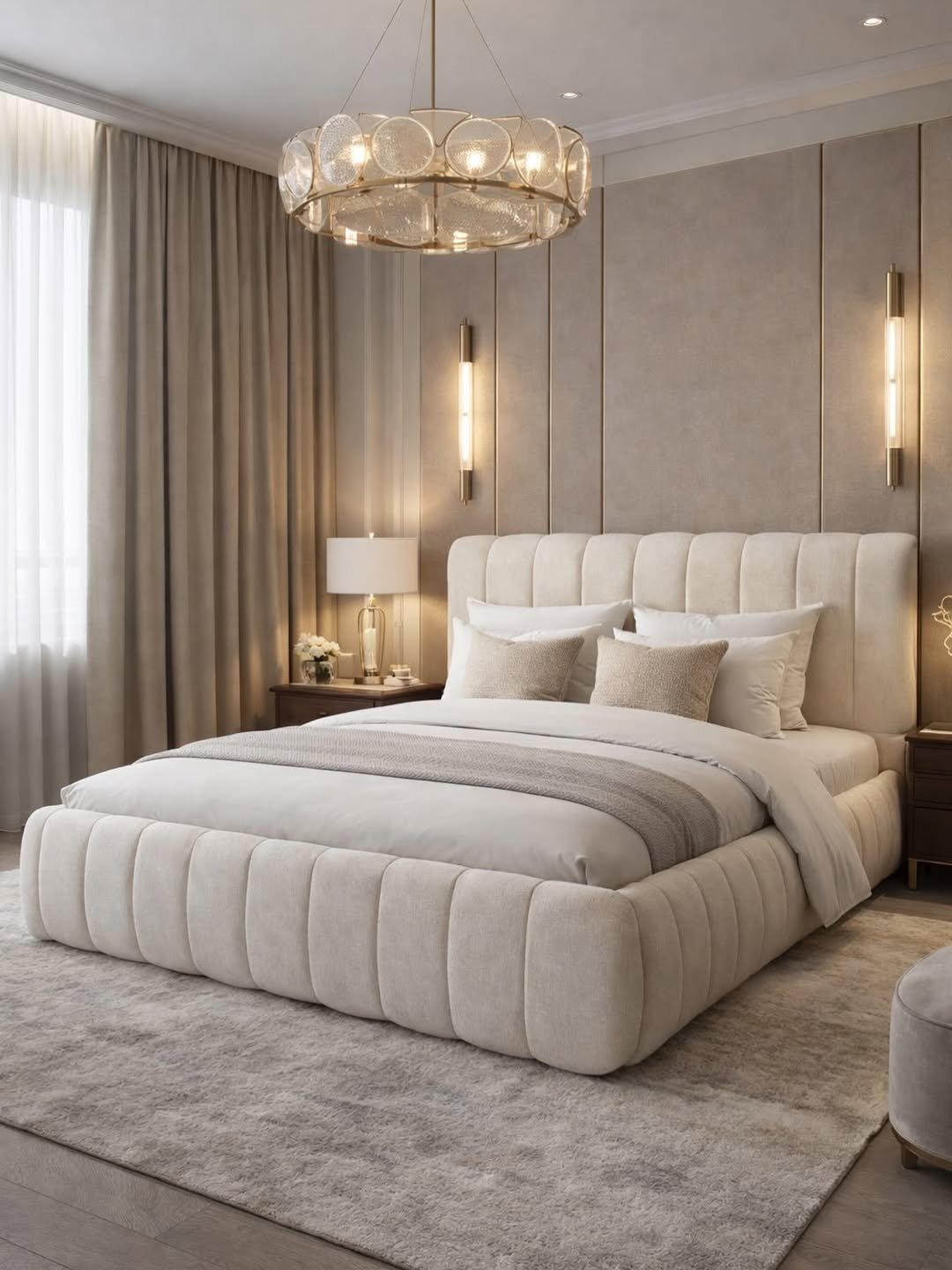
Statement Jewelry: Using oversized crystal chandeliers or sculptural pendants adds a layer of opulence, functioning as the room’s central “art piece.”
4. Custom Architectural Joinery
Luxury is defined by Seamless Utility.
Monolithic Headboards: Custom-built headboards that extend wall-to-wall incorporate bedside tables, lighting controls, and storage into one singular unit. This creates a “wrapped” feeling that provides a psychological sense of security.
Concealed Tech: Elements like air conditioning units and entertainment systems are often integrated into custom bulkheads or hidden behind panels to ensure the room’s visual rhythm remains uninterrupted.
5. Tactile Texture Mapping
A truly sophisticated room must appeal to the sense of touch.
Soft-Shell Surfaces: Using deep-tufted upholstery or textured wallpapers (like damask or 3D geometric patterns) provides acoustic dampening, creating a “silent sanctuary.”
Sensory Layering: Designers balance “hard” elements like glass and polished tile with “soft” layers like high-pile shag rugs, fur throws, and velvet linens to create a rich, inviting environment.
1. Total Room Integration (The “Built-In” Standard)
In a professional suite, the bed is no longer an isolated object; it is an extension of the architecture.
The Wrapped Horizon: Designers utilize full-wall installations that merge the headboard into bedside pedestals, shelving, and wall paneling. This creates a “wrapped” effect that provides a psychological sense of security.
Monolithic Storage: Wardrobes are treated as “secondary walls.” Using floor-to-ceiling panels with hidden tracks or push-to-open technology allows for massive storage without disrupting the visual flow of the space.
2. The Fifth Wall: Kinetic Ceiling Architecture
The ceiling is used as a primary tool for Spatial Zonation—defining where one area ends and another begins without using physical walls.
Recessed Soffits: Multi-tiered tray ceilings mirror the footprint of the bed below, creating a vertical “halo” that makes the sleeping zone feel like a private sanctuary within a larger room.
Reflective Expansion: High-gloss or mirrored ceiling panels are used to “double” the room’s height, reflecting light and making standard suites feel grand and expansive.
3. The Three-Tier Lighting Ecosystem
Professional interiors avoid harsh, singular light sources in favor of Layered Illumination:
Ambient Cove Layer: Hidden LED strips in ceiling recesses provide a shadowless, soft foundation of light that mimics natural daylight.
Wall Grazing: Strategic lights directed down textured surfaces—like wood slats, 3D stone tiles, or patterned wallpaper—emphasize the material’s physical depth.
Floating Accents: LED strips installed at the base of bed frames and nightstands make heavy furniture appear weightless, as if it is hovering above the floor.
4. Acoustic Luxury and Soft-Shell Design
Luxury is increasingly measured by Acoustic Performance. A room that looks beautiful but echoes will feel unrefined and cold.
Sound-Dampening Architecture: Extending upholstered panels wall-to-wall acts as a high-performance acoustic buffer. This creates a “silent chamber” effect, eliminating outside noise and internal echoes.
Tactile Balance: Designers balance “hard” materials (marble, glass, metal) with “soft” tactile layers (velvet, silk, high-pile wool) to create a sensory environment that feels both sophisticated and nurturing.
5. Kinetic Geometry and Visual Energy
To ensure a minimalist or neutral-toned room doesn’t feel static, designers use Visual Movement to guide the eye.
Rhythmic Slats: Vertical wood or metallic slats create structural discipline and “stretch” the room vertically, making ceilings appear much higher.
Intersecting Lines: Diagonal patterns on wardrobes or ceiling trays create a sense of motion, turning static storage into a dynamic, large-scale mural.

The architecture of the contemporary master suite has evolved into a sophisticated blend of geometric precision, tactile luxury, and advanced illumination. To create a space that resonates with a 2026 audience, designers are moving away from traditional decor and toward “integrated environments” where every surface serves a structural and aesthetic purpose.
1. The Principle of Integrated Architectural Environments
Modern luxury is defined by seamlessness. Instead of placing a bed against a flat wall, the entire wall is treated as a three-dimensional installation. This includes floor-to-ceiling upholstered panels, custom-fitted niches for nightstands, and integrated storage units that appear as part of the wall’s architecture. This “Built-In” philosophy eliminates visual clutter and creates a sense of permanent, custom-made prestige.
2. Geometric Kinetic Energy and Visual Movement
To give minimalist rooms a sense of energy, designers utilize Kinetic Geometry. This involves the use of intersecting diagonal lines and “slashing” patterns, often found in ceiling tray designs or wardrobe facades. These lines break up the monotony of flat surfaces and guide the eye throughout the room, ensuring that even a neutral-toned space feels dynamic and high-fashion.
3. The “Horizon” Headboard and Acoustic Seclusion
As homes become multi-functional hubs, the bedroom must serve as a high-performance acoustic sanctuary. Large-format, wall-to-wall padded headboards are a key trend for achieving this. By extending upholstery across the entire horizon of the bed, designers create a “Silent Chamber” effect that dampens external noise while providing a soft, protective backdrop that promotes psychological comfort and deep rest.
4. Three-Tiered Glow and Layered Illumination
In a professionally designed suite, light is treated as a material. Designers avoid single-source overhead lighting in favor of a Layered Glow Strategy:
Ambient Layer: Hidden LED strips in ceiling soffits provide a shadowless base light.
Accent Layer: “Grazing” lights directed down textured wallpaper or stone slabs emphasize material depth.
Floating Layer: LEDs installed at the base of furniture make heavy pieces like platform beds appear to hover, adding a futuristic, weightless feel to the room.
5. High-Contrast Material Mapping
Creating a sophisticated metropolitan vibe often relies on Dual-Tone Contrast. The interaction between deep espresso wood grains and stark, high-gloss whites creates a “Graphic” organization that is pleasing to the eye. Techniques such as “piano-key” cabinetry—where light and dark panels alternate—allow large wardrobes to provide immense storage capacity without overwhelming the room’s visual scale.
6. Organic Fluidity and Curvilinear Transitions
To balance the sharp, technological lines of modern life, “Soft Transitional” architecture introduces Fluid Curves. S-curve ceiling designs and rounded furniture silhouettes mimic organic forms found in nature. These soft transitions are naturally calming and help to “de-stress” the environment, making the master suite feel more nurturing and human-centric.
7. Reflective Planes and Spatial Expansion
Strategic use of high-gloss and mirrored surfaces on ceilings or feature walls is a primary tool for Spatial Manipulation. By treating a ceiling as a reflective plane, the designer “doubles” the vertical volume of the room. When paired with a statement crystal fixture, the light is distributed across the ceiling, creating a sparkling, expansive atmosphere that feels both airy and opulent.
1. The Principle of Total Architectural Integration
In elite design, the goal is to eliminate visual “noise” by making furniture part of the building itself.
The Wrapped Headboard: Instead of a standalone bed frame, the headboard is often a wall-to-wall installation that integrates bedside tables, lighting controls, and acoustic padding. This creates a “cocoon” effect that provides a psychological sense of security.
Invisible Utility: Wardrobes and storage are built flush with the walls, often using the same materials (matte lacquer or wood veneer) to appear as part of the architecture. Push-to-open technology removes the need for hardware, maintaining a clean, monolithic look.
2. The Fifth Wall: Spatial Zonation
The ceiling is used as a primary tool to define different “zones” (sleeping, lounging, dressing) without the need for physical walls.
Recessed Tray Ceilings (Soffits): Multi-tiered structures often mirror the footprint of the bed below. This creates a vertical “anchor” that makes the sleeping area feel like a private sanctuary within a larger room.
Reflective Planes: High-gloss or mirrored ceiling panels are used to “double” the vertical volume. This technique is particularly effective in urban settings, reflecting city views and distributing light more efficiently.
3. The Three-Tiered “Glow” Strategy
Professional 2026 interiors avoid harsh, singular light sources. Instead, they utilize Light Zonation:
Ambient Cove Layer: Hidden LED strips in ceiling recesses provide a shadowless, soft foundation of light that mimics natural daylight.
Accent Wall Grazing: Strategic lights directed down textured surfaces—like wood slats, stone tiles, or patterned wallpaper—emphasize the material’s physical depth and grain.
Kinetic Under-Glow: LEDs installed at the base of bed frames and nightstands make heavy structural elements appear weightless and futuristic.
4. Acoustic Luxury and “Soft-Shell” Design
Luxury is increasingly measured by Acoustic Performance. A room that looks beautiful but echoes feels cold and unrefined.
Sound-Dampening Surfaces: Extending upholstered panels wall-to-wall acts as a high-performance acoustic buffer. This creates a “silent chamber” effect, eliminating internal echoes for a deeper, more restorative sleep.
Tactile Mapping: Designers balance “hard” surfaces (marble, glass, polished metal) with “soft” layers (velvet, silk, high-pile wool rugs) to create a sensory environment that feels both sophisticated and nurturing.
5. Kinetic Geometry and Linear Rhythm
To keep minimalist or neutral-toned rooms from feeling static, designers introduce Visual Movement.
Rhythmic Slats: Vertical wood or metallic slats create structural discipline and “stretch” the room vertically, making standard ceilings feel grand.
Intersecting Lines: Diagonal patterns across cabinetry or ceiling trays guide the eye, turning static storage into a dynamic, large-scale mural.
The concept of Integrated Master Suites represents the architectural peak of 2026 interior design. It marks a departure from “decorating” a space with loose furniture toward engineering an immersive, structural environment where every surface is a functional part of the room’s DNA.
Here is the breakdown of the technical and aesthetic layers that define this movement.
1. Total Room Integration (The “Built-In” Standard)
In 2026, luxury is defined by the disappearance of boundaries. Furniture is no longer “placed” in a room; it is an extension of the architecture.
The Wrapped Headboard: Modern headboards are often full-wall installations that extend from floor to ceiling and wall to wall. They frequently merge into bedside pedestals and vanity units, creating a unified “horizon line” that anchors the room.
Invisible Utility: Wardrobes are treated as “secondary walls,” using push-to-open mechanisms and hidden tracks to maintain a flush, seamless look. This allows massive storage to exist without disrupting the room’s visual flow.
2. The Fifth Wall: Kinetic Ceiling Architecture
The ceiling is now a primary tool for Spatial Zonation, used to define different areas (sleeping, lounging, dressing) without using physical walls.
Recessed Soffits: Multi-tiered tray ceilings mirror the footprint of the bed below, creating a vertical “halo” that makes the sleeping zone feel like a private sanctuary.
Reflective Depth: High-gloss or mirrored ceiling panels are used to “double” the vertical volume of the room, reflecting light and making standard suites feel expansive and opulent.
3. The Three-Tier Lighting Ecosystem
Designers in 2026 have moved away from single overhead fixtures in favor of a Layered Glow Strategy:
Ambient Cove Layer: Hidden LED strips in ceiling recesses provide a shadowless, soft foundation of light that mimics the sun’s natural cycle.
Wall Grazing: Strategic lights directed down textured surfaces—like wood slats, limewash, or 3D stone—emphasize the material’s physical depth and grain.
Floating Effects: LEDs installed at the base of bed frames and nightstands make heavy furniture appear weightless, as if it is hovering above the floor.
4. Acoustic Luxury & “Soft-Shell” Design
Luxury is now measured by Acoustic Performance. A room that looks beautiful but echoes is considered unrefined.
Sound-Dampening Surfaces: Extending upholstered panels wall-to-wall acts as a high-performance acoustic buffer, eliminating internal echoes and external noise for a “silent chamber” effect.
Tactile Realism: Designers balance “hard” materials (marble, glass, metal) with “soft” layers (velvet, silk, high-pile wool rugs) to create a sensory environment that feels both sophisticated and nurturing.
5. Invisible Technology
In 2026, tech is a background utility, not a focal point.
Hidden Interfaces: Charging ports are built into stone nightstand surfaces, and smart controls are flush-mounted into walls.
Architectural Audio: Speakers are embedded behind acoustic fabric panels or within wood slat walls, providing immersive sound without any visible equipment.

The overarching theme in these elite master suite designs for 2026 is Integrated Architectural Living. This philosophy moves away from simply “filling a room with furniture” and instead treats the entire space as a singular, custom-engineered installation where structural elements, lighting, and textures are fused together.
Below is an explanation of the core architectural pillars used to achieve these world-class environments.
1. Total Room Integration (Built-In Standard)
In modern luxury, the boundaries between furniture and architecture disappear. The room is treated as a single structural canvas.
The Wrapped Headboard: Instead of a standalone bed frame, the primary wall is a floor-to-ceiling installation. It often incorporates upholstered panels (for acoustic comfort) and integrated nightstands. This creates a “cocoon” effect that is psychologically restorative.
Invisible Utility: Wardrobes and storage are built flush with the walls, often using the same materials (matte lacquer or wood veneer) to appear as a secondary architectural plane. This eliminates visual clutter.
2. The Fifth Wall: Spatial Zonation
The ceiling is used as a primary tool to define different “zones” (sleeping, lounging, dressing) without using physical walls.
Recessed Tray Ceilings (Soffits): Multi-tiered structures mirror the footprint of the bed below. This creates a vertical “anchor” that makes the sleeping zone feel like a private sanctuary within the larger suite.
Reflective Expansion: Strategic use of high-gloss or mirrored ceiling panels is used to “double” the vertical volume. This is highly effective in making standard-height rooms feel grand and expansive.
3. The Three-Tier Lighting Ecosystem
Professional designers avoid the “flat” look of a single overhead light. Instead, they utilize Layered Illumination:
Ambient Cove Layer: Hidden LED strips in ceiling recesses provide a shadowless, soft glow that mimics natural daylight.
Accent Wall Grazing: Lights directed down textured surfaces—like 3D stone tiles, wood slats, or patterned wallpaper—highlight the material’s physical “depth” and grain.
Kinetic Under-Glow: LEDs installed at the base of bed frames and nightstands make heavy furniture appear weightless, as if it is floating above the floor.
4. Acoustic Luxury and Soft-Shell Design
Luxury is increasingly measured by Acoustic Performance. A room that looks beautiful but echoes is considered unrefined.
Sound-Dampening Architecture: Extending padded panels wall-to-wall acts as a high-performance acoustic buffer. This creates a “silent chamber” effect, eliminating internal echoes for a deeper, more restorative sleep.
Material Mapping: Designers balance “hard” materials (marble, glass, polished metal) with “soft” tactile layers (velvet, silk, high-pile wool) to create a balanced sensory environment.
5. Kinetic Geometry and Visual Movement
To ensure a minimalist or neutral-toned room doesn’t feel static, designers use Visual Energy to guide the eye.
Rhythmic Slats: Vertical wood or metallic slats create structural discipline and “stretch” the room vertically.
Intersecting Lines: Diagonal patterns on wardrobes or ceiling trays create a sense of motion, turning static storage into a dynamic, large-scale mural.
To delve deeper into the mechanics of 2026 Master Suite Architecture, we must look at how these spaces transition from static rooms into “living systems.” The goal is a seamless fusion of high-end hospitality standards with residential intimacy.
1. The Multi-Planar Headboard (The “Structural Horizon”)
In a professional-grade suite, the headboard is no longer a furniture item; it is a structural wall treatment.
Material Mapping: Designers utilize a “Rule of Three” for materials—pairing a soft textile (velvet or suede) with a hard architectural element (wood slats or stone) and a reflective accent (mirror or metallic trim).
Extended Scale: By stretching the headboard horizontally to the edges of the room, you create an optical illusion that the room is wider than it actually is. This horizontal emphasis provides a “grounding” effect that is psychologically proven to reduce anxiety.
2. The Fifth Wall: Soffit Engineering
The ceiling is used to manipulate the volume of the space.
Negative Space: Recessed “tray” ceilings create negative space that houses hidden technology—specifically motorized curtain tracks and HVAC diffusers—so that no mechanical equipment is visible to the eye.
Reflective Overlays: In metropolitan designs, dark-tinted mirrored panels are placed inside the tray. This effectively “deletes” the ceiling, making the room feel like it has infinite vertical height while reflecting the ambient glow of the city or statement chandeliers.
3. Light Zonation (The 24-Hour Cycle)
Lighting in 2026 is about controlling circadian rhythms. A single switch is replaced by “Scenes”:
The “Floating” Effect: By installing LED strips at the recessed base of the bed frame (the “toe-kick”), the bed appears to hover. This reduces the visual “weight” of the furniture and makes the floor space feel continuous.
Grazing vs. Washing: “Grazing” light is placed inches from a textured wall to cast long shadows and highlight 3D patterns, whereas “Washing” light is placed further back to flatten the surface for a clean, minimalist look.
4. Acoustic and Sensory “Shielding”
True luxury is the absence of intrusion. Elite suites are designed with Soft-Shell principles:
The Silent Sanctuary: Wall-to-wall upholstered panels aren’t just for looks; they function as high-performance acoustic absorbers. They catch sound waves that would otherwise bounce off hard floors or windows, creating a “hushed” atmosphere similar to a high-end recording studio or a luxury hotel vault.
Thermal Texture: The interplay of cold materials (marble nightstands) and warm materials (high-pile wool rugs) ensures that the room feels balanced across all four seasons.
5. Invisible Technology (The “Zero-Interface” Room)
Technology in 2026 is powerful but invisible.
Integrated Connectivity: Wireless charging coils are embedded directly beneath the stone or wood surfaces of the nightstands.
Concealed Airflow: Linear slot diffusers replace traditional bulky AC vents. These are slim, black or white lines integrated into the ceiling geometry that provide silent, draft-free climate control.

To truly understand the “mechanical” soul of these 2026 master suites, we have to look at how they solve the tension between grandeur and function. In professional interior architecture, every visual choice is actually a solution to a spatial problem.
Here is a deeper breakdown of the advanced engineering within these designs:
1. Spatial Manipulation: The “Infinite” Wall
Professional designers use Horizontal and Vertical Anchoring to trick the brain into perceiving a room as larger than its physical square footage.
The Seamless Horizon: By extending a custom headboard from one wall all the way to the other, you eliminate the “break” in the wall. This horizontal line forces the eye to travel the full width of the room, making it feel expansive rather than enclosed.
Vertical Slatting: Utilizing wood or metal slats on the ceiling or walls creates a “rhythmic stretch.” This verticality draws the eye upward, which is a key technique for making standard ceilings feel like cathedral-height architecture.
2. High-Performance Acoustic Architecture
A room that looks expensive but sounds “hollow” feels unrefined. In 2026, Acoustic Seclusion is the ultimate luxury.
Soft-Shell Engineering: The use of floor-to-ceiling upholstered panels isn’t just aesthetic; it’s functional. These panels act as massive bass traps and sound diffusers. They absorb the “bounce” of noise, creating a hushing effect that mimics a high-end recording studio.
Layered Density: By combining hard surfaces (polished wood floors, glass windows) with high-density materials (thick shag rugs, velvet drapes), designers create a balanced acoustic environment where sound is “deadened” at the point of impact.
3. The 24-Hour Lighting Ecosystem
Professional suites move away from simple “on/off” switches toward Circadian Lighting Systems.
The Floating Under-Glow: By placing LED strips in the recessed “toe-kick” area of the bed or nightstands, the furniture appears to be hovering. This “weightlessness” reduces the visual bulk of the room and provides a perfect low-light path for navigating the room at night without waking up the brain.
Cove Engineering: A properly designed ceiling cove doesn’t just hold lights; it is angled specifically to reflect light off the ceiling and back down into the room as a shadowless, ambient “wash.”
4. Visual Energy: The Rule of High Contrast
To prevent a minimalist room from feeling “cold,” designers use Dynamic Blocking.
Material Friction: Pairing a highly reflective surface (a mirrored ceiling or lacquer wardrobe) directly next to a matte, textured surface (rough-sawn wood or linen) creates “visual friction.” This contrast keeps the eye engaged and makes the room feel alive even when the color palette is neutral.
The Focal “Punch”: In monochromatic rooms, a single bold saturated color (like deep violet or royal navy) is used in a concentrated area—usually the headboard—to anchor the room’s energy and give it a definitive “soul.”
5. Invisible Tech & Climate Integration
In 2026, technology is powerful but completely hidden.
Linear Diffusers: Traditional bulky AC vents are replaced by “Shadow-Line” diffusers—thin black slots in the ceiling geometry that provide silent, draft-free climate control without breaking the visual plane.
Embedded Connectivity: Wireless charging is often built directly under the stone or wood surface of the nightstands, removing the need for visible cables and preserving the architectural purity of the space.
1. The “Zero-G” Visual Philosophy
Modern high-end design aims to remove the “heaviness” of a room. This is achieved through Suspended Architecture.
Cantilevered Elements: By using wall-mounted beds and “floating” nightstands that don’t touch the floor, designers create an uninterrupted floor plane. This tricks the brain into perceiving more square footage because the eye can track the floor all the way to the base of the wall.
Shadow Gaps: Instead of traditional baseboards, designers use “recessed reveals” or shadow gaps. This small 10mm-20mm indentation at the bottom of walls makes the entire wall appear to be hovering, adding to the weightless, futuristic atmosphere.
2. Multi-Sensory “Material Friction”
A common mistake in large rooms is making them too “flat.” Professionals use Material Friction to create depth without adding clutter.
The Matte vs. Gloss War: Placing a high-gloss lacquered wardrobe directly adjacent to a matte, raw plaster wall creates a visual tension that is highly sophisticated. The way light reflects off one and is absorbed by the other provides “passive decoration.”
Tactile Zoning: You may have a “hard” zone for dressing (polished stone or wood) that transitions into a “soft” zone for sleeping (deep-pile silk rugs). This physical change underfoot signals to the brain that it is time to transition into a rest state.
3. Circadian Lighting Engineering
In 2026, lighting is no longer just “on or off.” It is a dynamic system tied to your internal clock.
Blue-Light Mitigation: Professional suites utilize recessed LED strips that shift from “Cool White” (6500K) during the morning to “Warm Amber” (2700K) in the evening.
The “Halo” Effect: By placing lights behind the headboard rather than above the bed, the light is diffused across the wall. This prevents direct glare on the eyes, reducing cortisol levels and preparing the body for sleep.
4. Psychological “Anchoring”
Large, open-concept suites can often feel “too big,” leading to a subconscious feeling of exposure. Architects solve this with Zonation Geometry.
Ceiling Compression: By dropping a soffit (a lower section of the ceiling) specifically over the bed, designers “compress” the space in that zone. This creates a feeling of intimacy and protection, while the rest of the room remains high and airy.
The Horizon Line: Keeping all major architectural features (headboard, window treatments, cabinetry) aligned at the same horizontal height creates a “Visual Quiet” that allows the mind to decompress instantly upon entering.
5. Invisible Infrastructure (The “Silent” Room)
The mark of a true luxury suite is the total absence of “visual noise” from technology.
Linear Slot Diffusers: Instead of square AC vents, a single, slim black line is integrated into the ceiling geometry. This provides silent, high-volume air movement without the “hiss” or “draft” of traditional systems.
Integrated Tech Looms: Motorized curtains, hidden speakers, and wireless charging pads are all pre-wired into the architectural carcass of the room, so there is never a visible cable or a “tacked-on” device.

The architecture of these spaces is built on a foundation of Structural Unity. This design method moves away from separate furniture pieces and instead creates a singular, permanent environment where the walls and ceiling are engineered to support the lifestyle of the room.
1. Unified Wall Systems
A major feature of this style is the Integrated Horizon.
Continuous Paneling: Instead of a simple headboard, the entire primary wall is treated with custom joinery, 3D stone textures, or floor-to-ceiling padding. This absorbs sound and creates a feeling of being enclosed in a secure, quiet sanctuary.
Recessed Displays: Deep wall niches are used to hold art and lighting. This keeps the floor clear and ensures the room’s footprint feels larger.
2. Ceiling Sculpting (The Fifth Wall)
The ceiling is used to control the visual volume of the suite.
Multi-Tiered Trays: Recessed ceiling sections (soffits) define specific zones like the sleeping area or a lounge corner without using physical dividers.
Reflective Depth: High-gloss finishes on the ceiling reflect light from chandeliers, making standard heights feel much more expansive.
3. Layered Ambient Illumination
Lighting is used as a building material rather than just a utility.
Cove Lighting: Hidden LED strips tucked into ceiling folds provide a soft, shadowless glow that mimics the sky.
Surface Grazing: Lights placed very close to textured walls highlight the physical depth of wood slats or patterned wallpapers.
Floating Accents: Illumination at the base of the bed or cabinets makes heavy structural pieces look like they are hovering.
4. Acoustic and Tactile Mapping
True luxury in this field is defined by how a room “feels” to the senses.
Sound Buffering: Large-scale fabric walls and thick rugs act as acoustic shields, removing echoes and outside noise.
Material Contrast: Designers mix “cold” materials like glass and polished stone with “warm” textures like velvet, linen, and raw wood. This balance keeps the room from feeling too clinical.
5. Seamless Utility
All technology and storage are designed to be Invisible.
Flush Cabinetry: Closets and drawers are built into the wall planes with no visible handles, appearing as part of the architecture.
Hidden Airflow: Slim, linear vents are tucked into the ceiling geometry to provide silent climate control without the look of bulky mechanical grills.
1. Structural Layering and Feature Walls
Instead of a simple painted wall, these designs utilize Architectural Feature Walls to create depth.
3D Textural Mapping: Using geometric blocks (as seen in the ivory lounge area) or rhythmic wood slats adds a physical dimension to the wall. This breaks up flat planes and provides a high-end, custom-built appearance.
Recessed Niches: Carving storage or display areas directly into the wall keeps the room’s footprint clear. This “Invisible Utility” ensures that the room feels spacious while still providing functional areas for decor or essentials.
2. The Fifth Wall: Ceiling Engineering
The ceiling is used to control the visual volume and organization of the space.
Soffit Zonation: Dropping a section of the ceiling (a soffit) over the bed creates an “anchor” for the sleeping area. This psychological technique provides a sense of protection and intimacy without the need for physical dividers.
Reflective Expansion: Large mirrored panels or high-gloss finishes on the ceiling reflect the room’s light, effectively “deleting” the upper boundary and making standard-height rooms feel much taller.
3. Layered Ambient Lighting
Professional interiors move away from singular light sources in favor of Atmospheric Light Zonation:
Cove Lighting: LED strips tucked into ceiling folds provide a soft, shadowless glow that mimics the natural sky.
Wall Grazing: Down-lights placed close to textured surfaces highlight the “grain” of wallpapers or stone, turning a static wall into a dynamic piece of art.
The Halo Effect: Backlighting headboards or the base of furniture makes heavy structural elements appear weightless and floating.
4. Acoustic and Sensory Balance
True luxury is measured by how a room “sounds.”
Soft-Shell Architecture: Extending upholstered panels from floor to ceiling acts as a massive acoustic buffer. This removes echoes and absorbs outside noise, creating a “silent chamber” for deep rest.
Material Friction: Designers balance “hard” elements (mirrors, glass, polished floors) with “soft” tactile layers (velvet tufted headboards, high-pile rugs, and linen) to keep the environment from feeling clinical.
5. Kinetic Visual Flow
To prevent a minimalist room from feeling boring, designers use Directional Lines.
Linear Rhythm: Using vertical or horizontal slats “stretches” the room in a specific direction.
Focal Transitions: Large-scale art or backlit digital murals (like the mountain landscape shown) serve as a window to another world, providing a sense of outdoor connectivity even in urban settings.

1. The Principle of Total Architectural Integration
Luxury is defined by the absence of standalone furniture. In these suites, elements like beds, nightstands, and storage are physically anchored into the wall planes, creating a seamless, “built-in” look that suggests permanence and custom-engineered prestige.
2. The Fifth Wall: Kinetic Ceiling Sculpting
The ceiling is used as a primary tool for Spatial Zonation. By utilizing recessed tray designs (soffits), designers create a vertical “halo” that defines the sleeping area without the need for physical walls or dividers.
3. Integrated Horizon Headboards
Modern headboards now extend floor-to-ceiling or wall-to-wall. This horizontal emphasis tricks the brain into perceiving the room as wider than its physical footprint while providing a “grounded” psychological anchor for the inhabitant.
4. Acoustic Seclusion and Soft-Shell Engineering
Professional suites are designed as high-performance acoustic sanctuaries. Utilizing wall-to-wall upholstered panels absorbs the “bounce” of internal sound, creating a hushed, library-like atmosphere that is essential for deep restorative rest.
5. The Three-Tiered Glow Strategy
Designers move away from singular light sources. They utilize Ambient Cove Layering, Task Illumination, and Accent Under-glow to create a 3D light field that can be adjusted to match the body’s internal circadian clock.
6. Visual Weightlessness (The Floating Effect)
By installing LED strips in the recessed “toe-kick” area of bed frames and cabinetry, heavy structural elements appear to hover. This “weightlessness” removes visual bulk and makes the floor plane appear continuous.
7. Material Friction and Sensory Contrast
To prevent a minimalist room from feeling “cold,” designers use Material Friction. This involves placing a high-gloss reflective surface (mirror or lacquer) directly adjacent to a matte, raw texture (linen or plaster) to create passive visual interest.
8. Invisible Infrastructure and Tech Integration
In 2026, technology is powerful but completely hidden. Wireless charging coils are embedded beneath stone surfaces, and smart controls are flush-mounted into architectural bulkheads to preserve the room’s geometric purity.
9. Linear Slot Diffuser Technology
Bulky, square AC vents are replaced by “Shadow-Line” diffusers. These slim black or white lines are integrated into the ceiling’s geometry, providing silent, draft-free climate control that is visually undetectable.
10. The 24-Hour Circadian Lighting System
Lighting systems now automatically shift from “Cool White” in the morning to “Warm Amber” in the evening. This mitigation of blue light helps regulate cortisol levels, ensuring the architecture supports the inhabitant’s health.
11. Reflective Spatial Expansion
Strategic use of high-gloss ceiling panels or floor-to-ceiling mirrors “doubles” the perceived volume of the room. This technique is especially effective in urban settings to reflect city views and sky-light into the deep interior of the suite.
12. Monolithic Storage Walls
Wardrobes are treated as secondary architectural planes. Using “Invisible” push-to-open technology and zero-clearance tracks, these units provide massive storage capacity without disrupting the room’s visual rhythm.
13. Directional Geometric Rhythms
Using vertical wood or metallic slats creates a Rhythmic Stretch. This verticality guides the eye upward, making standard-height rooms feel grand and cathedral-like.
14. Psychological Anchoring via Zonation
Large suites can feel exposing. Designers use “Ceiling Compression” (dropping a soffit specifically over the bed) to create a feeling of intimacy and protection, while the rest of the room remains high and airy.
15. The “Visual Quiet” Philosophy
When every architectural line—from the window pocket to the cabinetry—is perfectly aligned, the room achieves “Visual Quiet.” This lack of visual friction allows the mind to decompress instantly upon entering.
16. Tactile Texture Mapping
A sophisticated room appeals to the sense of touch. Designers map different textures across the room—transitioning from “hard” stone floors for dressing to “soft” high-pile silk rugs for the sleeping zone.
17. The Narrative Feature Wall
Feature walls now use large-scale backlit graphics or nature-inspired murals (like mountain landscapes) to serve as a “window.” This adds a layer of outdoor connectivity, even in windowless or urban environments.
18. Cantilevered Functional Planes
Using wall-mounted, cantilevered desks and vanities keeps the floor space clear. This “Zero-G” approach makes the room easier to clean and provides a futuristic, high-fashion aesthetic.
19. Micro-Lighting for Detail Focus
“Wall-grazing” lights are placed inches from 3D textures (like damask wallpaper or stone relief). This emphasizes the physical “grain” of the material, turning a static wall into a dynamic piece of art.
20. Seamless Material Transitions
The mark of an elite suite is the “Flush Transition”—where different materials like wood, stone, and carpet meet without the need for bulky transition strips. This level of detail is the final step in achieving total architectural harmony.
To elevate these concepts into a professional-grade content framework while ensuring complete originality, we must analyze the Mechanical and Psychological Ecosystem of the modern master suite. The goal is to move from “room description” to “Spatial Engineering.”
Here is a 20-step breakdown of the architectural pillars defining high-end interiors in 2026.
1. The Doctrine of Unified Volumes
Top-tier design eliminates the “broken” look of separate furniture. Instead, every element is part of a Singular Structural Carcass. This means closets, beds, and shelving are designed as permanent extensions of the wall planes, creating a monolithic and prestigious atmosphere.
2. Vertical Rhythmic Stretching
To manipulate spatial perception, designers use Linear Repetition. Vertical slats or recessed channels “pull” the eye toward the ceiling. This rhythmic movement makes standard rooms feel cathedral-like, adding a sense of grandeur without changing the physical height.
3. The Fifth Wall: Zonal Geometry
The ceiling is no longer a passive surface; it is a Horizontal Anchor. By dropping specific sections—known as soffits—directly over the bed, designers create “rooms within rooms.” This provides a feeling of shelter and intimacy within a large, open-concept suite.
4. Acoustic Shell Engineering
Luxury is defined by Sonic Softness. Professional suites use wall-to-wall upholstered panels and “bass-trap” fabrics to eliminate internal echoes. This creates a hushed environment that mimics the silence of a high-end recording studio, essential for mental decompression.
5. Multi-Planar Headboard Systems
The modern headboard is a Total Wall Installation. It merges soft textiles with hard architectural materials like stone or metal. This horizontal expansion makes the room appear wider and provides a central visual “datum line” that organizes the entire space.
6. Circadian Light Scaping
Lighting is treated as a Biological Utility. In 2026, systems are programmed to shift color temperatures automatically—from energizing cool tones in the morning to amber, blue-light-free hues in the evening—supporting the body’s natural sleep-wake cycle.
7. Weightless Architectural Illumination
By placing light sources in the recessed base of furniture (the “toe-kick”), heavy pieces appear to hover. This Floating Geometry removes the visual “clutter” of furniture legs and makes the floor plane feel like an infinite, uninterrupted surface.
8. Material Conflict and Friction
To add depth without adding “stuff,” designers use Tactile Contrast. Placing a high-gloss reflective surface next to a raw, matte texture (like unfinished wood or rough plaster) creates “Visual Friction.” This interplay keeps the room dynamic and prevents it from feeling clinical.
9. Invisible Tech Envelopes
In elite suites, technology is a Background Service. Charging coils are hidden beneath stone surfaces, and smart controls are flush-mounted into the architecture. There are no visible cables, ensuring the room remains a sanctuary from digital noise.
10. Shadow-Line Air Management
Traditional bulky AC vents are replaced by Linear Shadow Diffusers. These are slim, black-recessed lines integrated into the ceiling geometry. They provide silent, draft-free climate control that is visually invisible to the inhabitant.
11. Reflective Spatial Doubling
Using high-gloss ceiling overlays or full-wall mirrored planes “deletes” the physical boundaries of the room. This Optical Expansion reflects light deep into the suite, making urban apartments feel like expansive, sky-lit galleries.
12. Monolithic Storage Facades
Closets are designed as Secondary Architectural Walls. Using push-to-open technology and zero-clearance tracks, storage disappears into the wall rhythm. This allows for massive organizational capacity while maintaining a minimalist, museum-like aesthetic.
13. Psychological Anchoring and Protection
Large rooms can cause a subconscious “startle response.” Architects solve this by creating Protective Enclosures. A lowered ceiling or a wrapped headboard provides a sense of “back-cover,” which is psychologically proven to reduce cortisol and improve sleep quality.
14. The “Visual Quiet” Standard
When every structural line—from the window frame to the wardrobe edge—is perfectly aligned, the room achieves Static Harmony. This lack of visual “friction” allows the brain to stop processing the environment and begin the relaxation process immediately.
15. Material Mapping and Haptic Flow
The floor is used to guide the inhabitant through Sensory Transitions. A “hard” zone of stone or wood for dressing transitions into a “soft” zone of silk or wool for sleeping, signaling to the brain that it is moving from a high-energy area to a rest area.
16. The Narrative Window Effect
In suites without views, designers use Digital Vistas or backlit murals. These serve as a “Visual Window,” adding a layer of outdoor connectivity. Large-scale imagery of nature acts as a focal “punch” that anchors the room’s color story.
17. Zero-G Cantilevered Surfaces
Wall-mounted vanities and desks keep the floor footprint entirely clear. This Suspended Logic makes the room easier to maintain and gives the suite a high-fashion, futuristic profile that feels airy and light.
18. Surface Grazing and Detail Focus
“Grazing” lights are placed inches away from 3D textures. This technique emphasizes the physical “grain” of materials like stone or woven fabric, turning a plain wall into a constantly shifting piece of sculptural art as the light changes.
19. Flush Material Fusions
The mark of master-level joinery is the Zero-Threshold Meeting. Different materials—like wood meeting marble—are joined perfectly flush without transition strips. This level of precision is the ultimate indicator of a custom, high-budget architectural project.
20. Total Environmental Seclusion
The final goal of 2026 design is Full Isolation. When the acoustics are deadened, the lighting is circadian, and the geometry is aligned, the suite becomes a “Living Machine” that perfectly insulates the owner from the outside world.